


Blog
SoftWave Therapy for Desk Workers: Relief from Repetitive Strain

Desk Work Is Quiet Work on Your Body: SoftWave Therapy for Roanoke Office and Remote Workers
Sitting at a desk looks harmless, but many people who work at a keyboard all day tell us they hurt more than friends who lift and move for a living. If your wrists ache by mid-afternoon, your neck feels stiff when you look up from your screen, or your upper back tightens into a permanent knot, you already know how much a "low activity" job can cost. At InnerSun Family Chiropractic in Roanoke, VA, Dr Wendy Brown works with office staff, remote employees, and hybrid workers who want to feel good at the end of a workday. One of the tools she uses is SoftWave TRT, a non-invasive therapy designed to support healing in soft tissues overworked by repetitive strain.
This article walks through the pain patterns of desk life, how sitting and repeated typing feed them, how SoftWave TRT is designed to help, and a few practical workplace habits you can start today. Results vary from person to person, and a consultation is the right way to learn whether this approach fits you.
Why Desk Work Hurts: The Repetitive Strain Cycle
Repetitive strain is not one injury. It is the slow accumulation of small stresses on the same tissues, day after day, with too little recovery in between. When you hold a posture for hours and make the same small movements thousands of times, muscles fatigue, blood flow drops, and the tissues that stabilize your joints start to complain. Below are the patterns we see most often in desk workers.
Carpal Tunnel and Wrist Strain
Typing and mousing keep your wrists bent or extended for long stretches. Over time this can irritate the tendons that run through the wrist and crowd the narrow space where the median nerve passes. People describe tingling in the fingers, a weak grip, or an ache that creeps up the forearm. A high desk, an unsupported wrist, or a mouse that is too far away all make it worse.
Tech Neck and Upper Back Tension
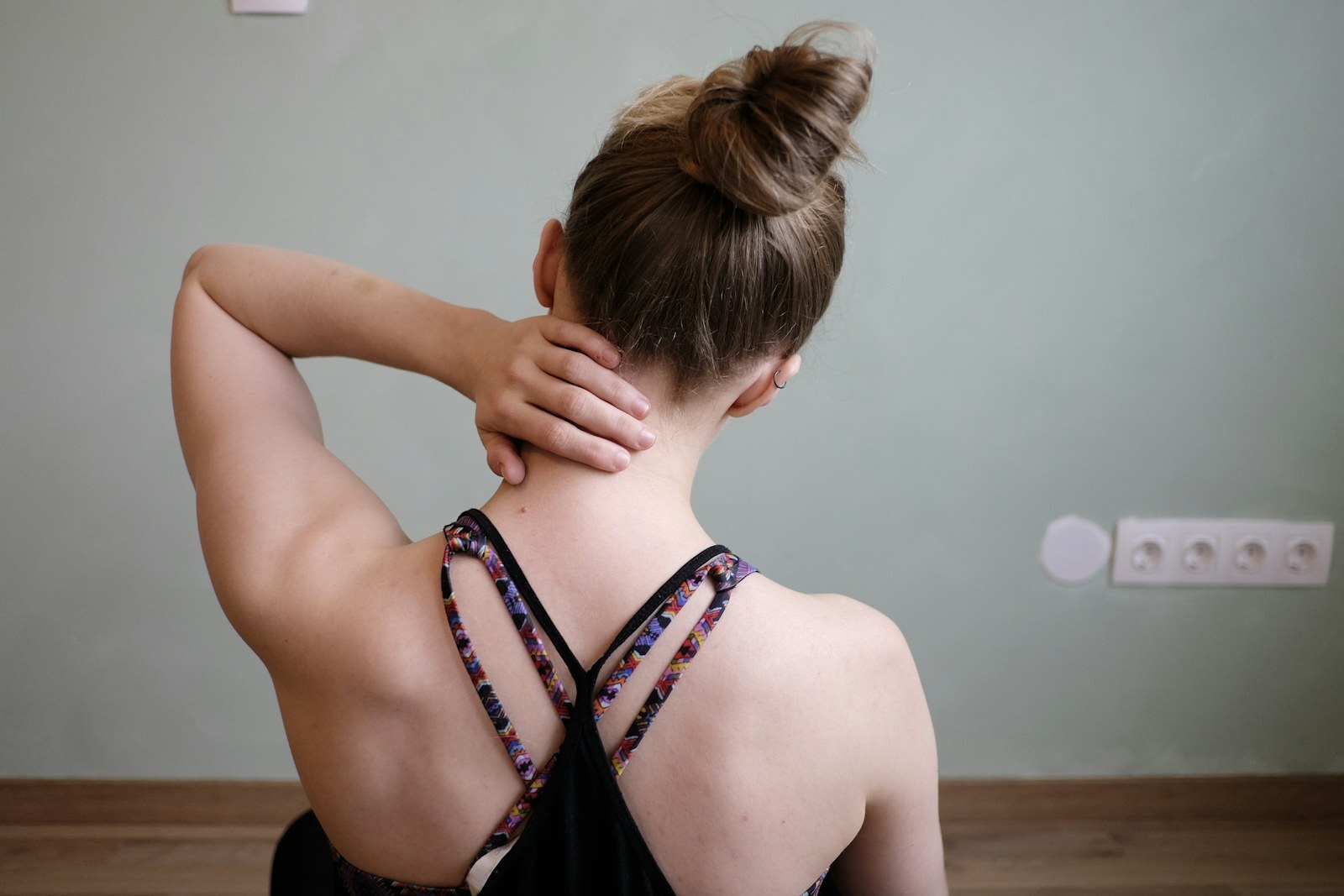
Every inch your head drifts forward toward a screen adds load to the muscles at the base of your skull and along your upper back. Hours of looking down at a monitor, laptop, or phone keep those muscles working overtime. The result is often a stiff neck, headaches that start at the back of the head, and a burning tightness between the shoulder blades.
Shoulder Tightness and Rounded Posture
Reaching forward to a keyboard tends to pull the shoulders up and in. The chest muscles shorten, the upper back muscles get stretched and weak, and the shoulders slowly round forward. That posture can pinch tissues around the shoulder joint and leave you carrying tension you can never quite shake off.
The Cost of Prolonged Sitting
Sitting itself adds another layer. Long periods without movement reduce circulation and allow hip and low back muscles to stiffen. Less movement means less fresh blood delivered to the very areas that are being strained, which is the opposite of what recovery needs.
How SoftWave TRT Supports Overworked Soft Tissue
SoftWave TRT uses electrohydraulic, spark-generated acoustic waves that are broad-focused through a patented parabolic reflector. That design sets it apart from radial, electromagnetic, and piezoelectric devices, and it allows the waves to spread through a wider area of tissue rather than a single narrow point. The waves penetrate deep and are designed to trigger the body's own natural healing cascade in areas that have taken on repetitive strain.
For desk workers, the appeal is that this is non-invasive. There are no needles, no drugs, no surgery, and no downtime, so you can typically return to your day right after a session. Sessions usually run about 10 to 15 minutes, and care is often delivered as a series over roughly 6 to 8 weeks. Because the therapy encourages your body's own repair processes, healing may continue for weeks to months after your final session.
What SoftWave Is Designed to Do, in Plain Language
- Activate resident stem cells: the waves are designed to stimulate the body's own repair cells and encourage them to migrate toward stressed tissue.
- Support new blood flow: through signaling molecules such as VEGF and eNOS, the therapy aims to promote angiogenesis, the formation of new blood vessels, where circulation has dropped.
- Encourage tissue building: factors like PCNA and BMP are associated with cell proliferation and collagen, which matter for tendons and other connective tissue.
- Modulate inflammation: the therapy is designed to help regulate the inflammatory response rather than simply mask it.
- Help tissue housekeeping: through toll-like receptor regulation and clearance of aged, worn-out cells, it aims to support a healthier tissue environment.
Among its FDA-cleared uses, SoftWave is recognized for the activation of connective tissue, a temporary increase in blood flow, and temporary relief of minor muscle and joint pain. Those line up closely with what desk-related strain involves: tired connective tissue, reduced circulation, and everyday muscle and joint aches. This is supportive care, not a guaranteed cure, and it does not replace medical advice.
Pairing SoftWave With Ergonomic and Chiropractic Care
SoftWave works best as part of a bigger plan rather than a standalone fix. Repetitive strain builds up because of how you sit, move, and set up your workspace, so addressing those root causes matters as much as supporting the tissue. At InnerSun Family Chiropractic, Dr Brown can combine SoftWave sessions with chiropractic care for joint movement and alignment, along with guidance on your posture and workstation. The therapy supports the tissue, while the ergonomic and structural work helps keep the strain from piling right back on.
If you spend your days at a keyboard in Roanoke and repetitive strain is wearing you down, request a SoftWave consultation at InnerSun Family Chiropractic to find out whether this approach is a good match for your body and your work.
Practical Habits for the Desk Worker
Whatever care plan you choose, small daily changes add up. Here are simple habits that support the same tissues SoftWave is designed to help.
Set Up Your Space
- Raise your monitor so the top of the screen sits at about eye level, which keeps your head from drifting forward.
- Keep your elbows near a 90-degree angle and your wrists in a neutral, straight position while typing, not bent up or down.
- Support your low back with your chair or a small cushion, and keep your feet flat on the floor.
- Move your mouse close enough that you are not reaching, which eases shoulder and wrist strain.
Move on a Schedule
- Stand, stretch, or walk for a minute every half hour to bring fresh circulation back to stiff areas.
- Roll your shoulders back and gently open your chest a few times an hour to counter the rounded, forward posture.
- Look away from your screen regularly and tuck your chin gently to give the muscles at the base of your neck a break.
- Rest your wrists and shake out your hands between long typing stretches.
None of these habits replace professional care, but together they reduce the daily load on your body and give any therapy a better foundation to build on. Because every person and job is different, the right combination for you is something to work out with a provider who can look at your specific patterns.
Ready to Take the Next Step?
If desk work has left your wrists, neck, or shoulders aching, a consultation can help you learn whether SoftWave TRT and a smarter workstation could bring you real relief. Reach out today and take the first step toward more comfortable workdays.
Request your SoftWave Therapy new patient visit online today
Contact InnerSun Family Chiropractic
InnerSun Family Chiropractic
3555 Electric Rd Ste J
Roanoke, VA 24018
Phone: 540-315-4115
Our Main Office Website: https://innersunroanoke.com/
‹ Back




 3555 Electric Rd Ste J